Buying a home is one of the biggest financial decisions you’ll ever make. While most buyers focus on location, price, amenities, and floor plans, many overlook one of the most important aspects of property ownership—legal documentation. Among the essential documents every homebuyer should verify are the Occupancy Certificate (OC) and the Completion Certificate (CC).
Although these two certificates are often confused with each other, they serve different purposes. Understanding the difference between an Occupancy Certificate and a Completion Certificate is crucial because these documents confirm whether a building has been constructed legally and is safe to occupy.
In this comprehensive guide, we’ll explain what OC and CC mean, their differences, why they are important, how to verify them, and why every buyer should check these documents before purchasing a flat. At AMBR Homes, we believe that informed buyers make smarter investment decisions.
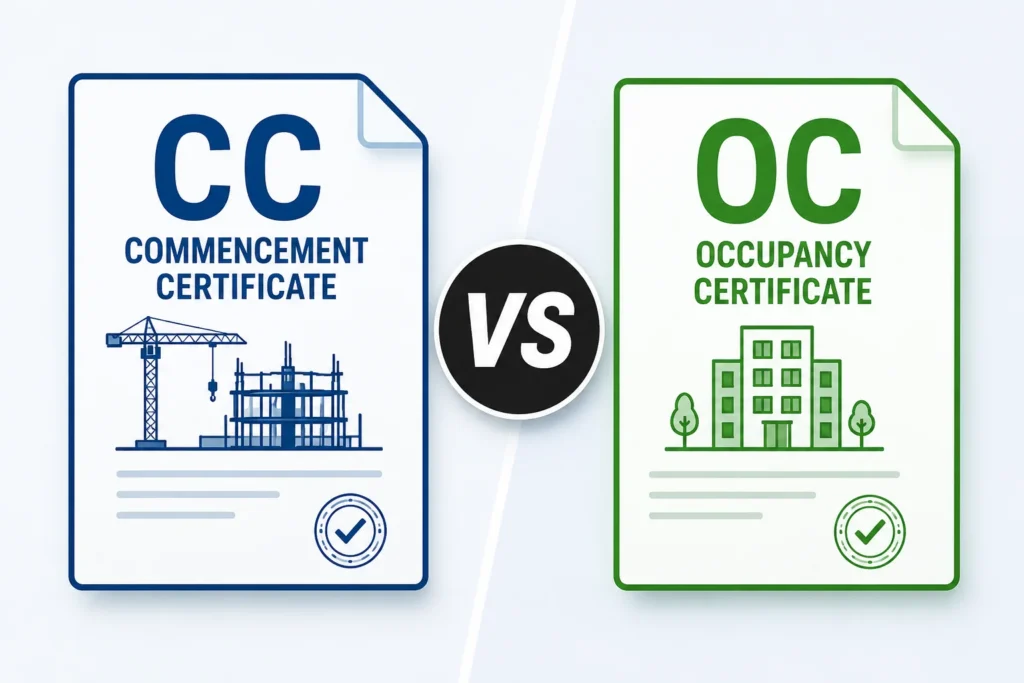
What Is a Completion Certificate (CC)?
A Completion Certificate (CC) is a legal document issued by the local municipal authority or development authority after a building has been constructed according to the approved building plan.
It certifies that:
- Construction has been completed.
- The building follows the sanctioned layout.
- Building bylaws have been followed.
- Safety norms have been complied with.
- Construction approvals have been respected.
In simple terms, the Completion Certificate confirms that the builder has completed the project as approved by the authorities.
Who Issues the Completion Certificate?
The Completion Certificate is generally issued by:
- Municipal Corporation
- Development Authority
- Local Urban Development Department
- Planning Authority
The issuing authority may vary depending on the state and city.
Why Is the Completion Certificate Important?
The Completion Certificate offers several benefits:
Confirms Legal Construction
It verifies that the project has been built according to approved plans.
Prevents Unauthorized Construction
If additional floors or illegal structures are constructed without approval, the Completion Certificate may not be issued.
Required for Occupancy
A builder generally needs a Completion Certificate before applying for an Occupancy Certificate.
Protects Buyers
It assures buyers that the project complies with government regulations.
What Is an Occupancy Certificate (OC)?
An Occupancy Certificate (OC) is a document issued by the local authority after inspecting the completed building and confirming that it is safe for people to occupy.
It certifies that:
- Construction is complete.
- The building follows approved plans.
- Fire safety norms are met.
- Water supply is available.
- Electricity connections are functional.
- Drainage and sewage systems are operational.
- The building is fit for occupation.
An Occupancy Certificate gives legal permission to residents to move into the building.
Who Issues the Occupancy Certificate?
The Occupancy Certificate is usually issued by:
- Municipal Corporation
- Local Development Authority
- Urban Local Body
- Planning Authority
After physical inspection, the authority confirms that the project is ready for occupation.
Why Is the Occupancy Certificate Important?
An Occupancy Certificate is extremely important because it confirms that the property is legally habitable.
Legal Occupation
Without an OC, residents may face legal complications while occupying the property.
Utility Connections
Many local authorities require an Occupancy Certificate for permanent water and electricity connections.
Home Loan Processing
Banks often ask for an Occupancy Certificate before approving loans for ready-to-move properties.
Better Resale Value
Properties with valid Occupancy Certificates are easier to sell and generally command better resale value.
Occupancy Certificate (OC) vs Completion Certificate (CC)
| Feature | Completion Certificate (CC) | Occupancy Certificate (OC) |
|---|---|---|
| Purpose | Confirms construction is complete | Confirms building is safe to occupy |
| Issued After | Construction completion | Inspection after completion |
| Issued By | Local authority | Local authority |
| Legal Requirement | Yes | Yes |
| Utility Connections | Does not guarantee | Usually required |
| Occupancy Permission | No | Yes |
| Importance | Confirms approved construction | Confirms legal habitation |
Key Differences Between OC and CC
1. Purpose
A Completion Certificate confirms that construction has been completed according to approved plans.
An Occupancy Certificate confirms that the completed building is safe and legally ready for residents.
2. Timing
The Completion Certificate is obtained immediately after construction is completed.
The Occupancy Certificate is issued only after the authority inspects the completed project.
3. Inspection
For an Occupancy Certificate, authorities inspect:
- Fire safety
- Lift safety
- Water supply
- Sewage system
- Structural compliance
- Electrical systems
The Completion Certificate focuses primarily on construction compliance.
4. Legal Importance
While both documents are essential, the Occupancy Certificate directly affects your ability to legally occupy the property.
Why Homebuyers Must Verify Both Documents
Buying a flat without checking these certificates can lead to:
- Legal disputes
- Delayed utility connections
- Difficulty obtaining home loans
- Problems during resale
- Municipal penalties
- Safety concerns
Always ask the builder to provide copies of both certificates before taking possession of a ready-to-move apartment.
What Happens If a Building Does Not Have an OC?
Living in a building without an Occupancy Certificate may result in:
- Delayed water connection
- Temporary electricity supply
- Municipal notices
- Difficulty selling the property
- Home loan complications
- Legal issues
This is why buyers should never ignore the Occupancy Certificate.
Can a Builder Sell Flats Without an OC?
Builders may sell under-construction apartments before an OC is issued. However, for ready-to-move projects, buyers should verify whether the Occupancy Certificate has been obtained before taking possession.
How to Verify an Occupancy Certificate
You can verify the certificate by:
- Asking the builder for a copy
- Checking the municipal authority records
- Visiting the local development authority
- Verifying details online where available
Always confirm:
- Project Name
- Builder Name
- Issue Date
- Certificate Number
- Property Address
How to Verify a Completion Certificate
Similarly, verify:
- Completion Date
- Building Approval Number
- Approved Floor Plan
- Issuing Authority
- Project Details
Cross-check these details with the approved building plan.
Common Mistakes Buyers Make
Many buyers:
- Focus only on pricing
- Ignore legal documents
- Skip verification
- Believe verbal promises
- Don’t consult legal experts
- Take possession without checking the OC
Avoid these mistakes to protect your investment.
Why Buying from a Trusted Builder Matters
A reputable builder maintains transparency throughout the home-buying process.
A trustworthy developer will:
- Provide legal documentation
- Register projects under applicable regulations
- Complete projects according to approved plans
- Assist buyers during possession
- Offer transparent communication
Choosing the right builder significantly reduces the risk of legal issues.
Why Choose AMBR Homes?
At AMBR Homes, we are committed to transparency, quality, and customer satisfaction. Our residential projects in Greater Noida West are planned with a focus on legal compliance, quality construction, and modern living.
Why Homebuyers Trust AMBR Homes
- Quality Construction
- Prime Location
- Spacious 2BHK & 3BHK Apartments
- Excellent Connectivity
- Modern Lifestyle Amenities
- Customer-First Approach
- Transparent Documentation
- Dedicated Support Throughout the Buying Journey
We believe that every customer deserves complete confidence before investing in a home.
Frequently Asked Questions (FAQs)
1. Is an Occupancy Certificate mandatory?
Yes, for ready-to-move properties, an Occupancy Certificate is an important document confirming that the building is fit for occupation.
2. What comes first, CC or OC?
The Completion Certificate is generally obtained before the Occupancy Certificate.
3. Can I take possession without an OC?
It is advisable to verify the Occupancy Certificate before taking possession, as it confirms the building is legally fit for occupancy.
4. Who issues the Occupancy Certificate?
The local municipal authority or development authority issues the Occupancy Certificate after inspecting the completed building.
5. Is a Completion Certificate enough?
No. A Completion Certificate confirms construction compliance, while an Occupancy Certificate confirms the building is safe and legally ready for residents.
Conclusion
Understanding the difference between an Occupancy Certificate (OC) and a Completion Certificate (CC) is essential for every homebuyer. While the Completion Certificate confirms that the building has been constructed according to approved plans, the Occupancy Certificate certifies that it is safe and legally ready for occupation. Verifying both documents helps protect your investment, ensures legal compliance, and gives you peace of mind.